
An intriguing game came to my attention and I just had to talk with the developer. The interview speaks for itself though…
1.) Tell us a bit about yourself.
My name is Sergey and I’m an independent game developer. That’s about it, really. I’ve been making games since I can remember – mostly they were prototypes and tabletop things, but I recently got exceedingly better at programming (that is not to say I’m good at it, just somewhat better than completely derp) and got used to the awesomest game development tool ever (yup, you guessed it, Unity), so I figured I might as well actually release something. That’s where Dédale comes in.
I also did some game journalism at a local branch of PC Gamer and other magazines and websites, but that didn’t really work out well, because writing about games took all the fun out of playing them for me, whereas developing games actually adds fun. It’s all subjective though, and does not mean that it works like that for everyone. I think that you should do whatever you enjoy doing the most. There’s no way you can become any good at what you do otherwise.
2.) Yeah. Most game journalists say that reviewing games isn’t fun. It really isn’t. You play games differently then if you would casually. Tell us a bit about Dedale.
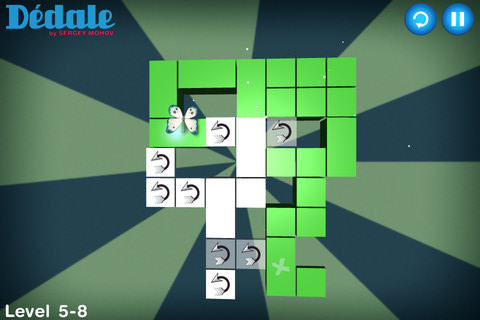
Dédale (or Dedale, doesn’t matter) is my first commercially released game, now available on iOS, Mac and PC and definitely coming to more platforms. Dédale is a puzzle game that makes the player lead a butterfly through increasingly more challenging mazes composed of piano keys, without backtracking. This sounds a bit odd when I say it like that, actually, but it’s really quite organic. You get a feeling that the sounds attract the butterfly as it flutters over tiles.
There are one hundred levels in the game, divided between seven worlds. New types of keys are introduced as you progress, hence more depth. I like to think that the core mechanic of the game, though simple, was explored in fullness. Sometimes a level doesn’t look all that different than the one before it, but it introduces a new concept, and as you learn these concepts, you develop a kind of an alphabet of approaches that you can apply later on in the game.
Here’s an example. There is a straight line composed of eight square keys. All of the keys are simple white ones that you can step on only once, except the two keys in the middle: those are transparent ones, which means that the player is supposed to step twice on each of them. As you make your way through that line and as you reach the first one of those transparent keys, you have to press the first transparent key (so it becomes white), then go one more key forward (that one becomes white too), then back again, and then forward again. This way, both transparent keys will become coloured. You remember what you did there, and you can apply it later in more complex situations. Oh, and you also get an achievement for that, it’s called “There and Back Again” and is awarded “for advanced maze techniques” 🙂
Dédale is all about that. It doesn’t have a tutorial. You have to discover things for yourself, learn and explore, all to an awesome relaxing soundtrack by my friend Rob FRACTURES. You can buy the OST on his Soundcloud, by the way, and I encourage everyone to do that.
3.) Where did the idea come from?
It’s kind of a funny story, actually. I was complaining on my Google+ about having to learn French, draw stuff and code all at the same time, and then Todd Barchok (who is also an indie game dev) joked that I should make a French game about drawing. At the same time the Unity Technologies’ “Flash in a Flash” competition was going on, so I figured I wanted to participate anyway, and that was as good an idea as any, so I did a short one-man brainstorm, made a simple prototype in my notebook, trashed a couple of bad ideas that didn’t work out and decided to pick the one that felt the best.
In 24 hours I had the first working version of Dédale with 10 levels. Then I think I made 20 for the competition. It was my first “game jam” and also turned out to be super fun. So I decided to finish this game, and I did. And I’m actually pretty happy with it.
4.) Are there any interesting stories involving the game’s development?
I think it’s funny how some people assume it’s a game that originated on iOS when they first see it. I didn’t even have an iPhone or a Mac when I started developing it, so it was a fundamentally desktop thing. True enough, the desktop version came out a week after the iOS version, but that’s only because of logistics. In fact, the game was first developed for the desktop, and then I struggled for a month (or more) to get the touch controls right and optimize everything to work on older devices such as 3GS and the first iPad.
Also, about a month and a half into the project, I had to apply for a master’s program in game design at a French university, and one of the things I had to do for it was write a design document and make a prototype of a game. So I put Dédale on hold for a week and a half to work on that. When I finished developing that game (it’s called The Mountain, by the way, you can download it for free somewhere), I went back to work on Dédale. That was then that I realized that all the code I wrote for it before was a steaming pile of feces. 🙂
I ended up rewriting the core mechanics of the game from scratch. It was super frustrating, but also showed me how much practice and perspective mean to a game developer.

5.) Tough question – do you think games can be art?
A long time ago I decided that I would not publicly reply to that question until people outside of the game industry start recognizing games as art. What I’m talking about is the main mass of games (that is to say, all of them) should be treated as art, and then this question won’t have any meaning any more. Until then, answering is pointless; We just have to work and see where it leads. You said “can be,” and that part of it sort of already says that the perception is not there yet.
As for art games, those are not games as much they are not art, they are just a separate entity that exists as a means of being a hipster for game developers (all indies are hipsters at heart, trust me on this).
6.) Do you have any tips to starting devs on how to get their games out there?
Nothing like the good old press release method. You should try to get your game in front of as many people as you can, to get them to play your game at all costs, and then, chances are some journalists/publishers/platforms will recognise your game’s real value and you will have achieved your goal.
Also, something more practical would be to say that any money you can spend on a marketing campaign will be wasted. There’s no easy way of getting one’s games out there for a small indie. You must establish a dialog with the media. Spending money on ads, promotions and (god forbid) paid reviews is not the way it works for us. In order for it to work, you must spend significantly more than you could ever hope to afford, which is exactly what big studios and publishers are doing all the time.
7.) Are you a big gamer? Do you have any favourites?
Not as big as I wish I were, unfortunately. I really don’t have that much time to look at everything, but I buy all Humble Bundles and an occasional Cypher, and make sure to play at least a few hours of everything I buy. Also, since I was born after the SNES era, I’m currently going through the abundance of incredible SNES games, and I’m amazed by their depth, storytelling and entertainment value. I have recently discovered Chrono Trigger, and I’m currently stuck at the Magus battle, so if you have any tips on how to beat him, feel free to send them in an email. 🙂
I’m always at a loss when people ask me about my favourite games of all time, so it’s never the same and is mostly composed of PC games from the 90’s, since that is when and where I played most games. If I were to pick one of those, however, I would certainly say The Neverhood. This is an amazing adventure game with claymation, and I think it influenced my work the most.
8.) Anything else to say?
I’d like to thank the Unity community and the awesome people in it. I could never have made it so far without you, guys.
And thank you for this opportunity to speak. 🙂
Site: http://dedalegame.com/
ABOUT THE AUTHOR: Nathan. He prefers his last name not to be known. He’s probably a high-class superspy, but we don’t mind. He is the editor of Indiegraph. He’s our point man for interviews, and occasionally he takes a blowtorch to a game to see whether it measures up to his standards.
 IndieGraph